By Edmond Ortiz
Officials in San Antonio and Cibolo are thinking of beefing up their regulatory tools to address the surge of data center developments. But a few elected leaders in each city say their constituents still want a brief moratorium or an outright ban on new data centers.
What is happening in San Antonio
San Antonio City Council was briefed Aug. 25 about the city’s available legal avenues in regulating data centers, the growth of which has become a source of controversy in numerous U.S. communities, and a political liability for some candidates running for public office in the November midterm elections.
Five San Antonio council members submitted a council consideration request last October to see how the city could amend its unified development code (UDC) as a means to regulate the establishment of data centers. More recently, three council members submitted a memo, asking to hold a special council meeting on the issue before the end of August.
City staff suggested that amending the UDC is the more effective route in dealing with data centers because it is a faster process that would result in codification of the zoning code, and a permanent solution vs. a temporary moratorium on new construction.
Possible UDC revisions could include such things as requiring minimum distances between data centers and residential neighborhoods, day care centers and schools, limiting their construction to specific zoned areas, large building setbacks, landscape buffers, and/or prohibiting their development on the Edwards Aquifer recharge zone.
Data centers that cannot meet these standards would be required to seek a specific use permit from the council, city staffers added.
The process of tweaking the UDC would involve stakeholder and public meetings, a mid-September zoning commission meeting, and a council decision as early as mid-October.
On the other hand, state law carefully guides the consideration of a building permit moratorium. In this case, the city must look at one of three options, issue specific written findings, and allow for a waiver application procedure.
If approved, a moratorium cannot last more than 90 days, but could be extended to 180 days with state authorization. Such a pause would not affect the vested rights of existing or in-development data centers.
According to city staff, even if council were to vote in early September to pursue a moratorium, following the state-mandated process, the city would not be able to enact a development pause until January 2027.
City Attorney Andy Segovia also warned the council against taking actions that could supersede the state’s current efforts to address the growth of data centers.
Gov. Greg Abbott in early August issued a statewide moratorium on new data center connections to the Texas power grid until the completion of an audit on electrical and water consumption by the planned facility.
San Antonio council lean to regulations
City Council members agreed that the increase in the number of data centers has rightly sparked concerns among residents, especially in areas where such a facility is operating or proposed for establishment there.
But Mayor Gina Ortiz Jones and most council members showed a preference for the UDC amendment route, acknowledging that a temporary moratorium or an outright ban could be too complex a step, or even one that potentially invites litigation from a data center developer.
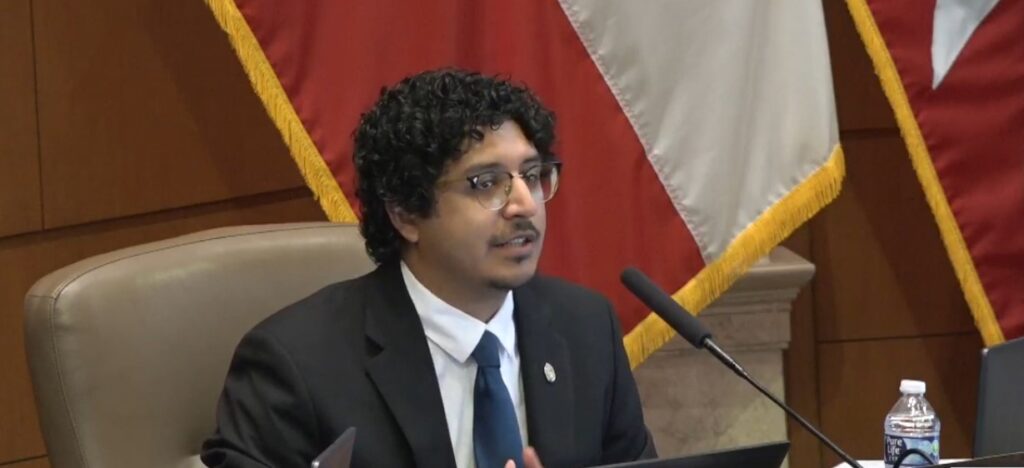
Although she did not broach some critics’ stated worries about data centers’ long-term impacts on local utilities and the environment, District 9 Councilmember Misty Spears said a moratorium could endanger economic development.
Spears added that data centers are job creators, and provide critical digital infrastructure to help support personal technologies, businesses, the military, governmental agencies and other end-users, especially with growing cities and the expanding use of artificial intelligence.
Spears also expressed confidence that future data center developers would work with the city and concerned neighbors to allay fears of negative adverse effects of their operations.
“San Antonio has a major economic opportunity in front of us, and a moratorium sends a concerning message,” she said in a post-meeting statement. “We should work to bring investment and good-paying jobs to our community, not encourage employers to take those opportunities somewhere else.”
District 6 Councilmember Ric Galvan, whose Far West Side area is a hub for data center development, called for a short-term moratorium and long-term regulatory enhancements. Additionally, he hopes state lawmakers, in the 2027 Texas Legislature, will weigh requiring data center developers to be more forthcoming in sharing their plans with a community.
“I look forward to creating policies that provide the opportunity for community members to have a say in where and how data centers are built in San Antonio, as well as pursuing a pause on data center development until these local policies are implemented,” Galvan said in a statement after the meeting.
The situation in Cibolo
Cibolo’s leaders, too, are wanting to adopt policies sooner than later while trying to stay ahead of one company, Legacy Investing’s, current plan to build a local data center.
Following an Aug. 17 town hall at Steele High School, Cibolo City Council agreed by consensus to direct city staff to organize a joint special meeting among the council, planning and zoning commission and the economic development corporation board.
There, those three panels will hammer out a set of proposed amendments to Cibolo’s UDC, which the planning and zoning commission would review and recommend any modifications. Council would then take up the proposed revisions for final approval.
The city could also consider specific use permit zoning (SUP) and conditional use permit (CUP) zoning as part of its regulatory push on data centers.
Cibolo officials agreed to publish on the city’s website a document containing residents’ frequently asked questions about Legacy Investing’s planned local data center.
The document has formal city responses to those questions, as well as existing information about the evolution of Legacy Investing’s data center proposal.
While Cibolo leaders, like their San Antonio counterparts, are presently favoring stronger land use and zoning regulations, neither a moratorium nor a ban is off the table. Cibolo’s city attorneys said either measure poses some amount of risk of litigation.
Mayor Kara Latimer said it is important that all levels of Cibolo city government be clear, consistent, firm and open in its messaging about potential data center regulations. ‘
Many Cibolo residents have complained that city officials appear to have been caught off guard about Legacy Investing’s data center plan.
“Even if we do a 100% (specific use permit) or a 100% (conditional use permit) or if we do or don’t do a full ban…I want the work done so (prospective developers) don’t catch us flatfooted again,” Latimer added.