By Edmond Ortiz
Kendall County commissioners unanimously voted Aug. 25 to not renew an agreement with Flock Safety Group, echoing residents’ concerns that the company’s technology could be abused, and considered a breach of people’s privacy.
What you should know
Kendall County and Flock’s partnership originally began last fall, launching a one-year term of service at a cost of $258,305 with 80% of that amount funded by a grant.
Commissioners Court was set to consider renewing the county’s pact with Flock in the upcoming Fiscal Year 2027, with the first renewal term starting Oct.1 at a cost not to exceed $198,550. Another grant would support 80% of that cost.
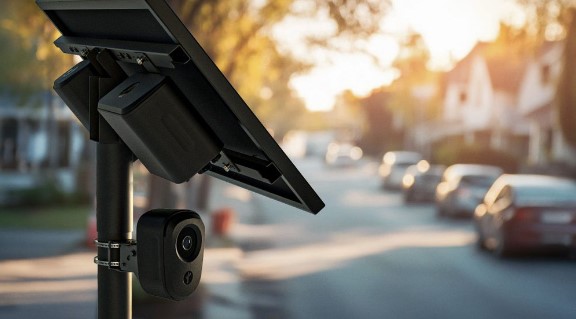
Flock’s automatic license plate reading-cameras have become enormously popular with law enforcement agencies nationwide.
Reportedly, 90,000-plus Flock cameras are deployed nationwide in public rights-of-way, and in private neighborhoods and businesses, including area communities around Bexar County, which is partnering with Flock. The city of San Antonio uses a different license plate reader provider, Axon.
Law enforcement agencies have championed Flock’s use of artificial intelligence in scanning passing vehicles, and sending information on each license plate number, and car make, model and color to a national vehicle surveillance database.
From there, law enforcement authorities can browse the database, search the past movements of a specific vehicle, or get real-time alerts on flagged vehicles.
Flock representatives and law enforcement officers working with Flock have said the company’s technology has been instrumental in tracking down stolen vehicles, identifying vehicles involved in criminal acts, or finding missing persons by looking at where a vehicle has been seen.
But civil liberties advocates and residents in many communities where Flock cameras are deployed have become increasingly critical of Flock’s presence, voicing concern that information uploaded to the national database may lead police to apprehend innocent individuals, or that authorities can abuse such tools.
What they are saying
Sheriff Al Auxier and fellow local law enforcement and justice system officials urged commissioners to stick with Flock, with Auxier calling the technology one of the most effective tools that any policing agency could ever possess.
Assistant District Attorney Steven Belt said Flock technology has proven useful many times in helping prosecutors to crack and close criminal cases. He added that in a growing area such as Kendall County, license plate readers such as the Flock cameras are especially useful because they cut down on the amount of time it takes for local authorities to locate a suspect.
Another assistant district attorney, Andrew Fields, said he has seen Flock technology helped to nab multiple sex offenders, and solve other criminal cases. He added that Flock cameras have the ability to assist with homicides and track down missing people.
Fields also asserted that criticism of such devices was more politically motivated, and lacking in accurate, objective information about how Flock cameras function. He and other Flock proponents sought to convince commissioners and the audience that the local government respects privacy and civil liberty laws, and that the devices do not do more than the things that detractors claim they do, such as harvest cell phone information.
Additionally, Auxier and county staff explained the elements of oversight and transparency that are involved in using Flock technology.
“I would say these Flock cameras are invaluable,” Fields added.
But several residents said, while surveillance cameras are a way of modern life, the use of Flock and similar cameras represent government overreach, and have yet to justify their high installation and service costs.
Other critics shared reports of authorities nabbing the wrong person based on information yielded by Flock technology. A couple of audience members also relayed reports where law enforcement officers use the smart cameras to stalk women.
Kristal Reser, crime analyst investigator in the Kendall County District Attorney’s office, said she has serious doubts about the technology that she and colleagues use to solve crimes.
“I’m not asking for a modification of this program. I’m asking you to defund it and discontinue it,” Reser told commissioners.
Flock creates a searchable record of the movements of ordinary citizens who are not suspected of committing a crime. Vehicles are photographed. Timestamp location stamps stored and searched simply because they pass your camera. We already know the consequences when these systems fail, like earlier this month in Wisconsin where two people were pulled from their vehicle at gunpoint after a Flock alert connected to their SUV to a homicide. The vehicle had already been cleared.”
Boerne resident Lenore Ockerberg said she was “appalled” that the county would deploy a surveillance system that might produce faulty information and lead to wrongful arrest of law-abiding residents.
“There will always be technology that can help make law enforcement’s job easier, but making law enforcement’s job easier cannot be the standard by which we decide how much privacy citizens must surrender,” Ockerberg said.
“I respect our law enforcement officers and the difficult job they voluntarily take on, but the difficulty of that job does not give the government unlimited authority to monitor law-abiding citizens, simply because the technology now makes it possible.”
Despite local law enforcement professionals’ reassurances and efforts to address what they called misinformation about Flock technology, commissioners have grown skeptical of the program nearly one year since the county permitted installation of Flock cameras.
“When I voted in favor of (this Flock program), I did so because we were told the primary purpose was to enhance public safety, protecting the people who live, work, and visit,” Commissioner Jennifer McCall said.
“However, over the past year and particularly over the last four months, additional information regarding Flock’s operations, data access, and data sharing practices has continued to emerge. As elected officials, we have a responsibility to ensure that any system implemented countywide adheres to clear standards for privacy, transparency, accountability, and local control. Based on the review of the current contract, I do not believe it provides sufficient assurance that data collected through the system will be adequately protected from access by outside entities.”
Commissioner Chad Carpenter initially supported the Flock system, but admits that his confidence gradually waned in the technology and how the recorded information could possibly be used in ways that were not originally intended.
“This whole deal really freaks me out, and I’m a hardcore constitutional person,” Carpenter said. “While I completely trust our sheriff, I don’t trust everyone.”