By Edmond Ortiz
When it comes to spending cuts and adjustments in developing San Antonio’s Fiscal Year 2027 budget, Mayor Gina Ortiz Jones is reiterating her stance that everything is on the table.
Where the mayor stands
The City Council will conclude a brief summer break and reconvene in August to face what local officials expect to be tough decisions on general fund budget expenditures and priorities.
Council was last fully briefed on the budget June 18 when it learned that the city may have to mull a property tax hike to help offset a slate of negative fiscal trends, such as inflation, escalating operational costs, a projected $158 million shortfall, and declines in revenues and property base valuations.
City staff currently projects a budget deficit rising up to $264 million by Fiscal Year 2031 if present negative financial trends continue, and if the city neither raises its property tax rate nor enacts serious cost-cutting measures.
Jones on July 22 repeated that she sees a property tax increase as a last resort, and urged council to consider both significant cost-cutting and efficiencies to maximize spending.
Even so, sweeping budget reductions may not be enough to eliminate a projected deficit. Jones said, as an example, if the city were to close all public libraries, eliminate Animal Care Services, and remove all general fund support for public health, a $20 million shortfall would still exist.
“Before considering residents paying more in taxes, I believe we have a responsibility to examine the entire city budget, eliminate unnecessary spending, and make sure every available dollar is being used wisely,” Jones said in one social media post.

Worries about cutting programs
Some residents and local media pundits focused on remarks that Jones made at the June 18 budget briefing where she combed through projected budget line-item expenses. She cited a few delegate agencies, nonprofits, events and privately held recreational amenities, such as the San Antonio Botanical Garden, that could possibly have their city funding reduced or entirely cut in lieu or essential basic city services.
Jones also had suggested that philanthropies and other private sector elements step in to help support such organizations as the botanical garden, which could conceivably see their annual city funding dry up if council agrees.
“My focus is on protecting the critical services San Antonians depend on while building a budget that respects the people who fund it,” Jones continued in her July 22 posting. “The first question should not be how much more residents can pay. It should be whether city government has done everything possible with the money it already has.”
To that end, Jones wrote to several local business, foundation, and philanthropic leaders July 24, inviting them to help fund or further support 15 organizations she proposes for potential cuts, including the botanical garden and its $1 million allocation, and the San Antonio Education Scholarship Partnership and Outreach Program and its $2.4 million allocation.
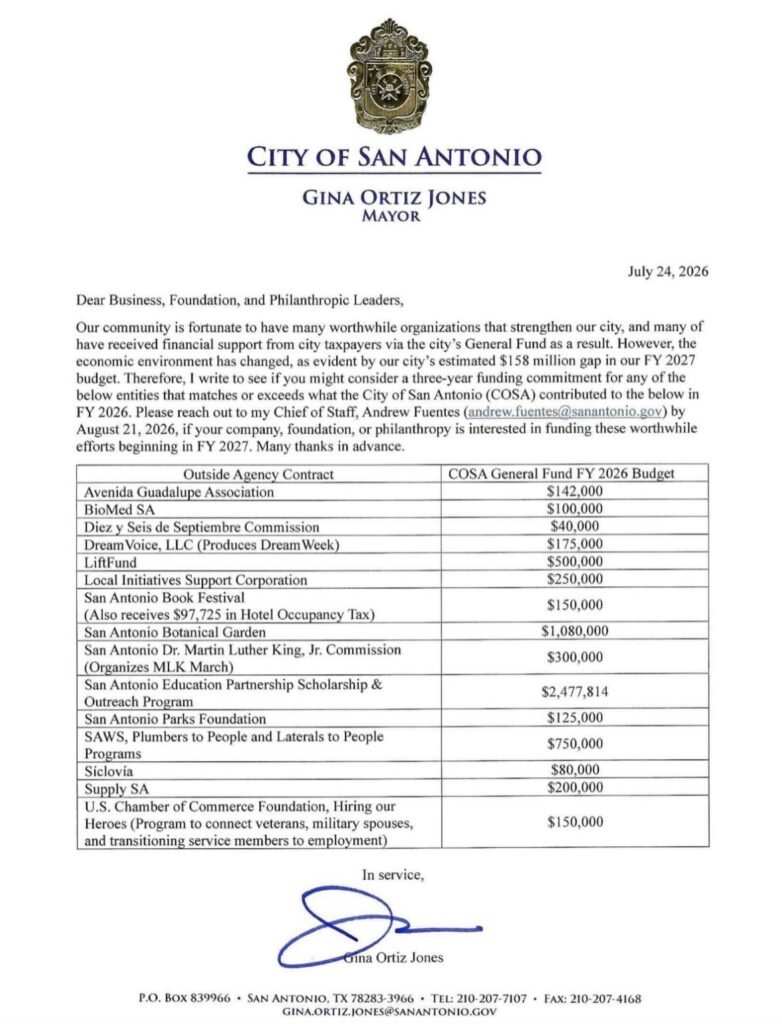
“We are facing a difficult economic environment, and it has to be all hands on deck to meet the need. Knowing what outside resources may be available will be critical for upcoming budget discussions,” Jones said in a July 25 social media post. “Lots of tough conversations ahead as we work to close the $158 million budget gap, minimize cuts to services impacting the most vulnerable, and try to avoid raising property taxes at all costs.”
The city’s San Antonio Ready to Work program, too, has popped up as a potential target for a budget reduction or elimination.
While Ready to Work has many public and private sector supporters, some civic leaders and other community members have voiced concerns that the workforce development initiative is still falling short of expectations that local officials outlined upon its inception in 2020, and that its budgetary allocation could be put to better use elsewhere.
Since June 18, many residents and media pundits have questioned whether Jones and the council will follow with such cuts, even if they prove unpopular with clients and supporters of those organizations and initiatives eyed for a reduction.
District 9 Councilmember Misty Spears, one of two conservative council representatives, recently signaled a rare instance of agreement with Jones on scrutinizing such budgetary expenses as Ready to work.
“The mayor and I may disagree on where these tax dollars should go, but I have no problem ending government programs that cost taxpayers hundreds of millions and fail to deliver the results they promised,” Spears said in a statement.
“If Ready to Work isn’t working, then it’s time to redirect those dollars to the basics – more police officers, better support for first responders, fixing our streets, and the core services taxpayers expect.”
What is next?
City staff will present the council with a full proposed FY 2027 budget Aug. 13. Council will meet Sept. 17 to adopt a final budget and property tax rate, with the new budget taking effect Oct. 1.
Residents can review the proposed FY27 budget and offer input in a series of town halls taking place in each council district Aug. 17-28. Meeting details can be found here.