By Edmond Ortiz
Affordable housing advocates are pushing two separate yet vital measures meant to deter further gentrification on San Antonio’s traditional West Side.
Community land trust approved
City Council on Sept. 3 designated Esperanza Community Land Trust, which is designed to help preserve a handful of existing West Side homes toward ensuring affordable rental and homeowner housing remain in place in key neighborhoods.
The local nonprofit Esperanza Peace and Justice Center applied with the city in 2022 to establish a West Side community land trust to support affordable homeownership opportunities as a means of stabilizing socioeconomically challenged neighborhoods, and building wealth for homeowners who otherwise may be unable to buy a house because of related high costs.
Instead, community land trusts make it possible for limited-income households to own homes on land that is leased from a specific trust through a renewable long-term lease. More than 300 CLTs are operational in the United States.
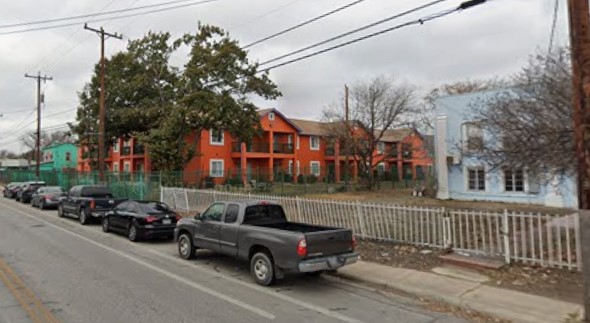
The Esperanza Center, which champions multiracial, multicultural and bilingual cultural arts and social change, will operate the Esperanza CLT, affecting a 1.53-square-mile area bound by Interstate 10/35, Commerce, Zarzamora and Laredo streets.
Within that area, the Esperanza land trust will acquire and renovate up to 14 single-family homes, and offer affordable rental housing and homeownership opportunities to households earning at or below 30% area median income, which is $100,600, according to the U.S. Department of Housing and Urban Development.
Homeownership within the Esperanza CLT zone may be available to families earning up to 50% AMI. Within the Esperanza CLT zone, a homeowner owns the house, leases the property from the trust, earns equity, and pays property taxes based only on the home’s restricted value. The trust also limits how much money for which a home in that zone can be resold.
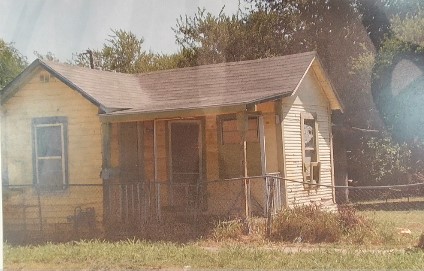
The Esperanza CLT will function with $681,400 that council awarded to the trust last April from the city’s voter-approved 2022 affordable housing bond. So far, the Esperanza trust has acquired 10 properties.
While organizations operating community land trusts may request a 50% exemption from city property taxes, the Esperanza Center is not seeking an exemption at this time.
The CLT will be overseen by a board that includes renters and homeowners occupying the housing that was acquired and renovated by the trust, as well as neighbors and other public stakeholders.
Local officials said they view community land trusts as a valuable asset in the city’s Strategic Housing Implementation Plan, a multi-year effort aimed at increasing the production of new affordable housing and preservation and repair of existing homes.
Graciela Sanchez, Esperanza Center’s executive director, told council that the city’s failure to prevent the redevelopment of the Mission Trails Mobile Home Park, a South Side property, last decade motivated her organization to promote using community land trust as a way to stave off displacement of socioeconomically residents elsewhere.
Graciela Sanchez said the Esperanza Center urged local housing organizations and agencies to set up a CLT in high-risk areas such as the inner West Side. But when nothing happened, officials with the nonprofit took matters into their hands.
“We need to find a way so that low-income families stay in their traditional neighborhoods, and have those neighborhoods benefit from public investment that has been long delayed,” Graciela Sanchez added.
Rene Gonzalez, general manager for the Esperanza CLT, said the traditional West Side was once a source of high rates of homeownership earlier in the 20th century. But area neighborhoods have declined partially because of lack of reinvestment and economic development from the city.
Gonzalez added that older housing, mostly because of their proximity to downtown, have been targeted by out-of-town investors eager to buy and flip such properties for high-end redevelopment that tend to price out long-time residents.
“The CLT designation and bond funds award are a first step toward addressing not only the affordable needs of the neighborhood, but also one of the lowest-performing areas in the Strategic Housing Implementation Plan,” Gonzalez said.
“While the need for affordable housing is great across all income levels, it is greatest for those below income levels where they could become displaced, made homeless, forced to move into substandard housing, or move further out to find affordable housing.”
According to Gonzalez, the new Esperanza CLT is focused on the traditional West Side because it contains a high concentration of houses built before or during World War II, and many area residents historically have struggled to age in place in such deteriorating structures without financial means to fix their home.
Gonzalez added that, as time goes along, the Esperanza land trust will share with the community the results of local contractors’ efforts to increase energy efficiency and improve heating, cooling and ventilation of older West Side housing, starting with the homes procured by the CLT.
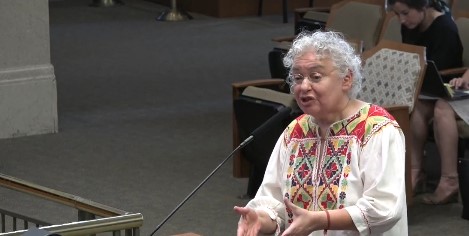
Leticia Sanchez, co-chair of the Historic Westside Residents Association (HWRA), a neighborhood group backing the Esperanza CLT, said many area residents frequently contact her organization for help with addressing unaffordable home repairs required by code compliance.
Leticia Sanchez said the Esperanza land trust will go a long way toward both positively affecting the housing it is acquiring and rehabilitating, and the surrounding neighborhoods that could secure long-overdue attention.
Some West Side residents also said that their challenges in maintaining safe housing have been exacerbated by a recent storm that caused major damage across the West Side and other neighborhoods around town.
“Our residents are generational homeowners, they don’t want to leave our neighborhood, and they want their homes and properties to remain with their family, so this is a way for people to do that,” Leticia Sanchez added.
Designating an Esperanza Community Land Trust, however, was not a unanimous vote. Councilmembers Phyllis Viagran, Marc Whyte and Misty Spears voted against it. They sought to delay action for more discussion about the operational aspects of a land trust, and cited concern about state lawmakers wanting to place more parameters on land trusts when the Texas Legislature convenes in 2027.
Viagran also was critical of the Esperanza trust in that, in her view, it has strayed from the traditional concept of land trusts, which is rooted in securing land for future sale or development, and into preserving and rehabilitating existing housing stock. She also felt the trust was moving too slow because only one renter and one homeowner have been identified in the zone to date.
But Gonzalez and Graciela Sanchez said the housing bond funds have been awarded, and the designation was merely a formality to cover activities being provided by the land trust.
“We’re already doing the work,” Gonzalez added.
Preserving Alazan-Apache Courts
Esperanza Center, HWRA and other local grassroots groups are advocating for another West Side landmark with hopes of saving it and maintaining its affordability for residents.
The Texas-based organization Latinos in Heritage Conservation recently announced the placement of the Alazan-Apache Courts in its latest group of Endangered Latinx Landmarks.
During the Great Depression, the city used a mix of local and federal funding to develop San Antonio’s first public housing community, replacing a series of slums that had stood near Alazan Creek west of downtown since the early 1900s.
After completion, 1,180 low-rent housing units at Alazan-Apache Courts accommodated nearly 5,000 people who had access to a range of on-site social and recreation services including a library, health clinic, nursery school, and adult education classes.
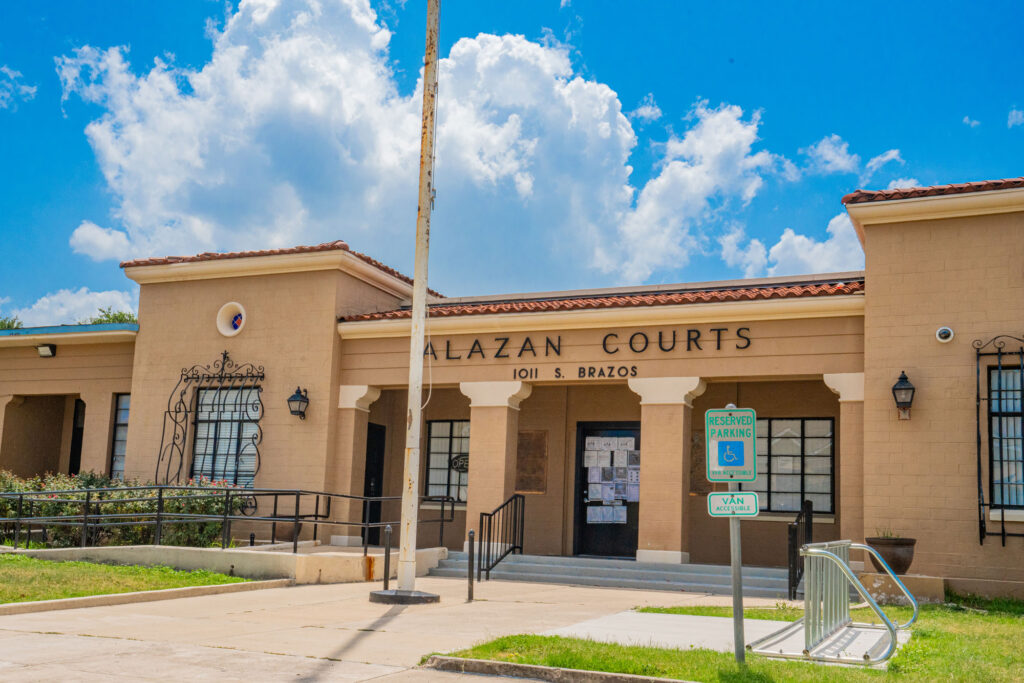
But Alazan-Apache Courts – also called “Los Courts” by locals – fell into neglect and became a scene of criminal activity in the 1980s and 1990s. While some parts of the neighborhood have been renovated or rebuilt, many tenants over the following years would take issue with various problems, such as illegal evictions, excessive fees, and false lease violations.
Now called Alazan Courts, the public housing complex is home to 1,800-plus residents living in nearly 700 housing units. Opportunity Home San Antonio – formerly the San Antonio Housing Authority – has a working master plan to improve Alazan Courts.
But local affordable housing advocates say designating Alazan-Apache Courts an Endangered Latinx Landmark with LHC will help to raise awareness about the community’s history, and a need for it to remain a safe, accessible place for socioeconomically challenged residents to live.
“These places hold our families’ sweat, our children’s education, our art, and our very identity—yet they face immediate risk of erasure and are too often overlooked by the nation’s preservation system,” LHC said in a statement.
“Every nomination was driven by local communities who refuse to let these histories disappear. Now, we need you to see them, share them, and stand with them.”
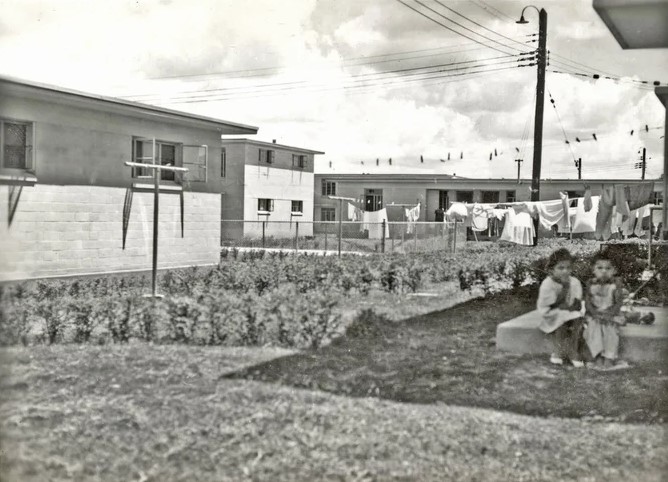
Esperanza Center officials echoed LHC’s shared sentiments about preserving places such as Alazan-Apache Courts from the threat of demolition and higher end redevelopment. “Los Courts” is located within the newly designated Esperanza Community Land Trust zone.
“This recognition highlights the stories, histories, and community connections that make the Alazán-Apache Courts an important part of Latinx heritage,” Esperanza Center said in a statement.
“Being included on the list helps bring greater visibility to this place and the ongoing efforts to honor and preserve its legacy.”