By Edmond Ortiz
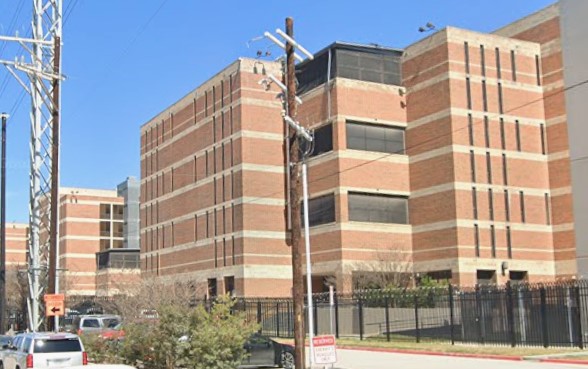
A Bexar County commissioner and grassroots groups are keeping up public pressure on local officials to improve conditions at the Bexar County Jail after another recent death of a detainee, and increasing complaints about overcrowding and mishandling of inmates with medical and mental issues.
Meanwhile, Comal County leaders are themselves contending with local jailing space challenges.
A campaign for change in Bexar County
A press conference is taking place July 28 at the Bexar County Courthouse where three nonprofits are unveiling what the event organizers call a response to continuing deaths at the Bexar County Adult Detention Center.
According to a press release, the self-proclaimed “care not cages” framework offers comprehensive efforts to prevent further in-custody deaths, bolster medical and mental health care and support for jail staff, as well as a means to help protect detainees’ families, and establish measurable accountability.
The news conference comes on the heels of the death of Jessell Constancio, 49, who died while in custody at the Bexar County Jail. According to the Bexar County Sheriff’s Office, Constancio was booked into jail on July 4, charged with prostitution with three or more prior convictions.
Authorities said Constancio suffered a seizure and stopped breathing while confined to her housing unit. She is the seventh person to die while in custody at the Bexar County Jail this year, and the 92nd since 2020. Hers is the fifth death attributed to an apparent medical episode this year in the Bexar County Jail.
According to data provided by Texas Jail Project, one of the press conference organizers, many of the people who have died at the Bexar County Jail over the last six years were still awaiting trial and had not been convicted of a crime.
Organizers decried past discussions among local officials over expanding the existing jail, building a new jail, or adding more detention beds in response to deaths of detainees or worries about overcrowding.
Designed for 4,500 inmates, the Bexar County Jail has been at capacity at exceeding 90% capacity, prompting the county to spend $3 million-plus to house inmates at jails in Burnet and Kerr counties.
Organizers asked Bexar County to instead develop a comprehensive way of facilitating detainees from the time of arrest. Representatives from the news conference participants urged Bexar County to improve how it transports and books arrestees, screens them for medical and mental health conditions, and provides housing.
The same organizations are also requesting changes in pretrial services and how detainees are treated in custody, an increase in diversion alternatives, enhancing communications with arrestees’ family members, and widening transparency on how a detainee’s death is investigated, and insurance of accountability.
The search for jail diversion alternatives for arrestees with behavioral issues has been made more difficult with downsizing at Laurel Ridge Treatment Center, where multiple claims of safety policy violations have led to cuts in Medicare and Medicaid funding, and a reduction of services and staff layoffs.
The organizers said all agencies and bodies of authorities that have oversight or other function at the jail, including University Health, the district attorney’s office, and contract medical and behavioral health providers must be part of meaningful reform.
“More jail beds will not correct missed medical warning signs, interrupted medications, untreated withdrawal, failed mental health referrals, delayed court action, weak communication between agencies, or the lack of meaningful accountability after serious failures,” Steve Huerta, executive director of All of Us or None Texas, said in a statement. “This framework is about preventing death by fixing the system at every point where intervention is possible.”
The news conference organizers said their framework proposal should not be seen as an attack on law enforcement, medical providers or other jail employees or contractors, or on local judges.
Rather, organizers said, they want to help Bexar County to address what they see as increasingly unsafe conditions for inmates and staff – challenges that have been exacerbated by inadequate staffing, and difficulties in responding more effectively to medical and behavioral health crises.
Press conference organizers lauded the county’s recognized Restoration Center and jail diversion efforts as proof that a different approach is possible.
“This is about building a system that protects everyone,” Huerta said in a statement. “It must protect the people in custody, support the staff responsible for their care, respect grieving families, and give the public honest information about whether problems are actually being corrected.”
A commissioner aims to force the issue
The press conference also follows recent comments that Pct. 3 County Commissioner Grant Moody provided via his latest email blast to constituents.
The Commissioners Court’s lone Republican was set July 7 to lead fellow commissioners in a public discussion about the aforementioned challenges at the Bexar County Jail. Yet, an executive session preempted that presentation, and the court voted to delay the conversation until August.
There have been recent talks elsewhere about ways that Bexar County could address jail overcrowding. Commissioners last April touched upon the idea of using mental health housing space at the county’s Applewhite Recovery Center on the South Side.
Also, District 5 City Councilmember Teri Castillo filed a council consideration request to create a joint city/county committee to oversee a diversion center, which would serve low-level offenders.
Castillo is also leading a July 29 roundtable talk about how local authorities can fill systemic gaps to help justice-involved individuals reintegrate into society and find job and educational opportunities. The meeting takes place 6-8 p.m. at the county’s reentry center, 222 S. Comal St.
But a frustrated Moody said Bexar County may have fewer opportunities to enact meaningful action on such issues as overcrowding, jail diversion and mental health resources ahead of the Texas Legislature reconvening in January 2027.
Moody said he was recently invited to testify before the Texas Senate Committee on Intergovernmental Affairs about Bexar County’s jailing needs, but he declined because he feels the county lacks a clear, long-range strategy.
“We owe it to the people of Bexar County to confront these issues head-on, work with our partners, and advance real solutions that improve public safety while better serving those experiencing mental health crises,” Moody said in his message to constituents.
The situation in Comal County
Comal County, too, is at capacity with its 583-bed jail, which opened in 2020. However, the jail will soon start to house inmates from nearby counties mostly because of population growth along the Interstate 35 corridor.
Comal County’s inmate population is increasing 23% annually, and its incarceration rate is slightly higher than the state’s average. Now, county leaders are taking steps toward expanding the existing detention center.
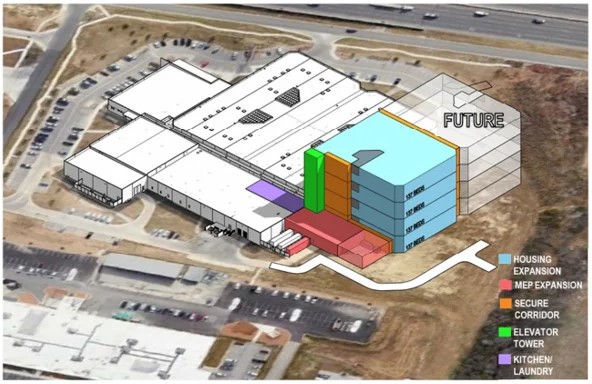
Consulting firm HDR led Comal County Commissioners Court on a feasibility study presentation on May 14. Afterward, commissioners asked county staff to analyze ways that the county could finance an estimated $170 million-plus potential jail expansion project.
Among multiple building options offered by HDR, the one being currently pursued by Comal County would involve expanding the present jail with a four-story tower, add 548 beds, and be adequate enough to serve the county’s detention needs through 2046.
County officials also said they would seek financing options that do not entail a tax hike.