By Edmond Ortiz
A majority of San Antonio’s elected leaders said they want to pursue ways to help protect local residents as the federal government ramps up local immigration law enforcement actions, but some city officials said there is only so much the city can legally do.
What is happening
City Council voted 9-2 on Feb. 12 to pass a resolution asking city staff to implement ways to protect residents during an increase in opportunities of direct engagement between local police, civilians, Immigration and Customs Enforcement officers and other agencies tied to immigration law enforcement.
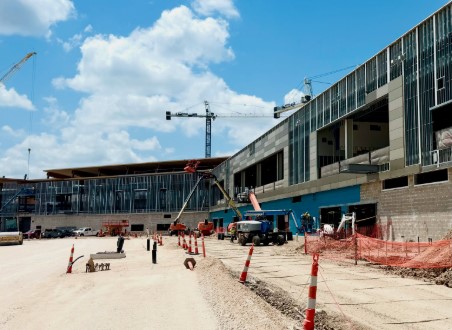
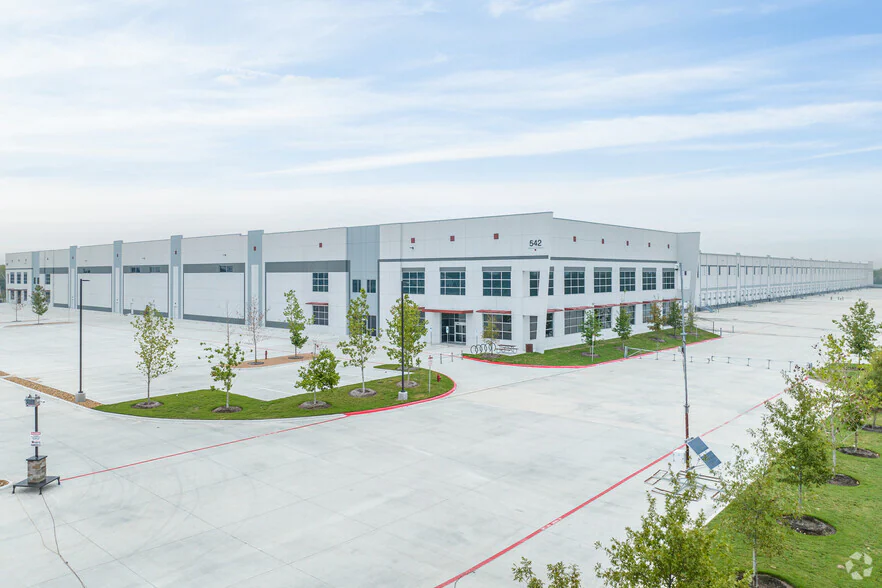
A rising number of local leaders and residents have expressed concern about ICE’s recently completed purchase of an Oakmont 410, an empty, nearly 640,000-square-foot warehouse at 542 S.E. Loop 410 – a structure that ICE plans to turn into a 1,500-bed “processing center” for detained undocumented immigrants.
Four council members submitted a Feb. 5 memo, requesting the city place a moratorium on non-municipal detention facilities within city limits.
Council members also asked whether the city could prevent ICE from fulfilling its plans with the East Side warehouse, and if the city could have a better handle on the bureaucratic approval process involved with any development of local migrant detention facilities in the future.
Additionally, the four council members who authored the memo — Jalen McKee-Rodriguez, Edward Mungia, Teri Castillo, and Ric Galvan – are seeking:
*An evaluation to determine whether any such federal detention facility complies with federal laws;
*Public signage informing residents and merchants of their constitutional rights;
*Training of city staff on rights and responsibilities to prevent harm that might be caused during immigration law enforcement efforts; and
*Creation of a report detailing migrants’ local economic impact.
The council vote came one day after Mayor Gina Ortiz Jones issued a statement, asking San Antonio’s Congressional delegation to reject any funding bill that would support ICE establishing a detention center in San Antonio.
In her letter, Jones scoffed at some people’s notion that ICE setting up a local detention facility would create jobs.
According to Bloomberg News and Washington Post reports, San Antonio is one of 23 U.S. locations and one of four Texas locations eyed for a new migrant detention facility. ICE is expected to spend $38 billion acquiring these warehouses nationwide and turning them into detention centers.
Many local immigration advocates and detractors of ICE have protested the operation of a detention center in Dilley, Texas.
“I would offer a better way to increase jobs: eliminate the tariffs that have driven up costs in our community, and reverse the proposed cuts to Medicare, Medicaid, CHIP, and SNAP as part of the One Big Beautiful Bill Act,” Jones said in her recent statement. “Such steps would actually help people.”
The local proposed ICE warehouse lies in City Council District 2. That district’s representative, McKee-Rodriguez, said he does not advocate any ICE protester or critic physically putting themselves at risk of arrest or harm at a scene where an ICE officer is arresting someone.
But, he added, the city should explore all legally viable options where it could seek more transparency from the federal government, and ensure local residents know their rights.
“The purpose of this memo was to ensure that we’re really turning over every possible stone and looking at every possible action that we can take as a city, as well as to inventory those things that we’re already exploring, and actively working to implement that,” he said.
What’s doable and not doable
The city’s attorneys elaborated on the council members’ requests into 26 areas of what actions the city is already undertaking, what things are feasible or can be evaluated, and what measures would be too risky for the city to carry out.
City Attorney Andy Segovia and First Assistant City Attorney Liz Provencio said the city would evaluate these issues as much as possible.
But Segovia and Provencio said it is likely they cannot guarantee outcomes that would please a majority of council members or the many audience members who implored the local government to push back even harder against ICE and the Trump administration.
Provencio warned city leaders against backing measures that may go against the federal government or run counter to state laws, such as 2017’s Senate Bill 4, and possibly jeopardize the city’s ability to secure federal or state funds in the future.
Two of the council’s most conservative members, Marc Whyte and Misty Spears, voted “no” on the resolution. Both council members echoed the city attorneys’ sentiments, adding that people – civilians and local police alike – are not legally allowed to interfere with federal officers’ law enforcement actions.
“We want to be sure that there’s no mismatched expectations because we will not be able to prevent immigration enforcement within San Antonio,” Provencio said. “We want to reiterate the constraints that we have to live within.”
Council held a special Jan. 22 meeting mainly to hear from residents and from local police leaders about their roles and responsibilities when it comes to ICE officials enforcing immigration laws.
While SB4 mandates the city and San Antonio Police Department to cooperate with federal agencies in enforcing federal immigration laws, the state law bars SAPD officers from asking civilians about their immigration status during interactions.
What else are they saying
Still, many of the 30-plus attendees who addressed council on Feb. 12 said they want the city to do all that it can legally do to make sure San Antonians keep safe despite ICE expanding its local operations.
Several meeting attendees said critics of ICE – from people taking part in protests to high school students participating in campus walkouts – should feel secure while practicing their First Amendment rights.
One speaker, Rosie Sanchez, said while ICE claims it is pursuing criminals and illegal immigrants, many innocent people including legal citizens are being arrested and detained in crowded, inhumane conditions.
“We are calling on communities, utility providers, and legal advocates to refuse to support these (detention) facilities,” Sanchez said. “We are calling on communities to block the expansion of these facilities by demanding utilities providers to not supply services to these facilities and hold them accountable if they do. We’re demanding that local governments not issue permits for their expansion, using legal avenues to challenge them.”
McKee-Rodriguez and some meeting attendees emphasized the importance of civilians knowing their rights, especially if they find themselves at risk of arrest. Many legal advocacy groups such as the Immigrant Legal Resource Center offer training sessions or provide digital and printable cards to remind individuals of their constitutional rights and helpful tips if they are confronted by ICE agents. Such rights and tips include:
*The right to remain silent.
*Remain calm and do not run away.
*If an ICE agent knocks on one’s door, the person answering the door should be polite and should not lie in responding to an officer’s requests.
*Demand a judicial warrant before letting ICE agents into one’s home or business. Ask an agent to produce a warrant by slipping it under a door or showing it through a window.
*If an ICE agent is looking for someone else, the person answering the door may ask the officer to leave contact information.
*The right to speak with a lawyer, if arrested, and the right to refuse to sign any document shown by an ICE agent.
*The ability to photo or video an arrest so long as they do not interfere in any way.
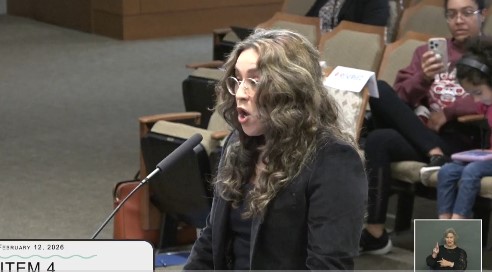
Priscilla Olivares, a senior policy attorney at the Immigration Legal Resource Center, addresses San Antonio City Council on Feb. 12. She said the city and its police department must seek accountability and greater transparency in working with Immigration and Customs Enforcement. (Photo courtesy of the city of San Antonio)
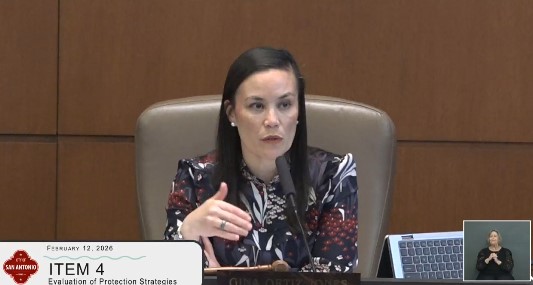
San Antonio Mayor Gina Ortiz Jones addresses a City Council meeting discussion Feb. 12 on the federal government increasing its crackdown on illegal immigration. (Photo courtesy of the city of San Antonio)
Immigration and Customs Enforcement recently completed acquisition of a vacant, 640,000-square-foot East Side warehouse and proposes to convert it into a 1,500-bed “processing center” for detailed undocumented immigrants. (Photo courtesy of LoopNet)