By Jason P. Olivarri
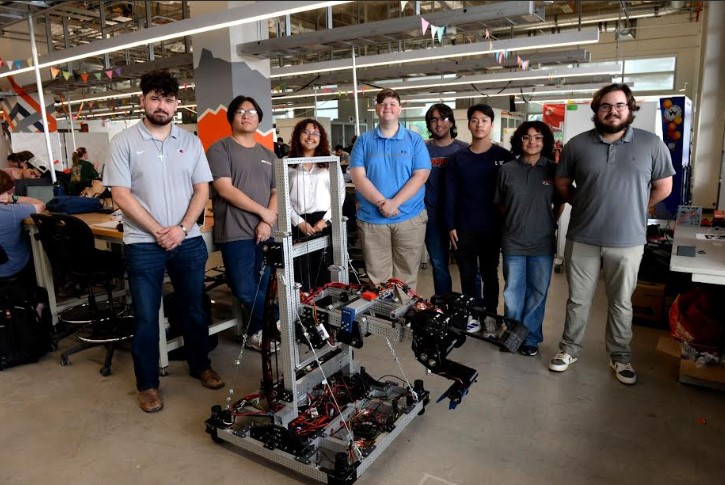
While most freshmen are still finding their footing, nine University of Texas at San Antonio students are preparing to represent the city on a global stage of engineering innovation.
Out of nearly 1,900 entries worldwide, UTSA’s team is one of 54 semifinalists in the Siemens Immersive Design Challenge — and one of only eight U.S. universities to advance. Every member of the team is in their first year.
A robot built to solve a real problem
Inside a UTSA lab, their creation — RoboRowdy — moves between 3D printers, using sensors and artificial intelligence to remove finished parts, clear machines and start new jobs without human intervention.
It may look simple. In modern manufacturing, it isn’t.
“Printers remain idle for over seven hours a day,” said team member Israel Elizondo. “That’s wasting time, materials and energy.”
In large-scale 3D printing operations, machines don’t run continuously. Workers must manually reset the process after each job. RoboRowdy automates that process, detecting when a job is finished, servicing the machine and starting the next one.
For manufacturers, that downtime adds up.
“Companies don’t want to use 3D printers for mass production because of that,” said Jacob White, a freshman mechanical engineering student and the team’s founder.
From dorm kitchen to working system
The project didn’t start in a research lab. White recruited teammates he met in his dormitory kitchen — a setting that proved fitting.
Before arriving at UTSA, he interned with Siemens, where he saw firsthand the inefficiencies of industrial 3D printing. That experience gave him both the technical background and the conviction to get freshmen solving real engineering problems from day one.
“My initial goal was just for us to submit something,” he said.
That modest aim grew into a full engineering project, designed, built and tested by students who had barely started college.
Overcoming setbacks
Turning the idea into a physical machine proved harder than expected.
“When we actually printed the parts, some of them didn’t fit as easily as expected,” said Andre Romo, who worked on the robot’s design. “We made the measurements so exact the parts wouldn’t fit. We were basically forcing them together.”
That meant redesigning components and adapting under tight deadlines.
On the software side, the team needed a system that could communicate with printers and external servers without expensive tools — a constraint that forced them to get creative.
“We had to find something that could connect to an external server without costing a lot of money,” said Dyshana Torres, who coded the system.
Then, after months of trial and error, it worked.
“I just looked at the screen and thought, ‘wow, it actually does work,’” Torres said.
An underdog team on a global stage
The students knew from the start they were facing more experienced competition.
“We’re competing against Ph.D.-level students,” White said. “You don’t need seven years of experience to build a robot. You just need the work ethic.”
Faculty members took notice.
“Normally this would be a senior design project,” said Don Petersen, director of engineering, innovation and design at UTSA’s Klesse College of Engineering. “They did it in three or four months.”
Petersen said the students drove the project themselves.
“I wish I could take credit, but they did most of the work,” he said.
Part of a larger vision
That philosophy is taking shape across the university.
UTSA recently opened San Pedro II, a 180,000-square-foot downtown facility anchoring its College of AI, Cyber and Computing, part of a broader effort to connect students with industry and position San Antonio as a growing technology hub.
“The goal is to connect students with real-world industry problems,” Petersen said.
What’s next
As of publication of this article, the UTSA team was waiting to learn whether it would advance to the final round of the Siemens competition.
Regardless of the outcome, White said the experience has already proved something.
“Everyone here should be proud of what they put together,” he said. “Hundreds of hours went into this — and it all came together into a working product.”
For a group that started with an idea in a dorm kitchen, RoboRowdy is more than a class project.
It’s a working solution to a real-world problem — and an early sign of what this team may be capable of.
Editor’s note: The UTSA group, Team 210 Robotics, was announced July 9 as the global winner of the 2026 Siemens Immersive Design Challenge.