By Edmond Ortiz
Debbie McDaniel remembers Jan. 11, 2022, the day that changed her life – the day she finally received a liver after awaiting a transplant for years.
“I cried that day. I cried when they took me down to the operating room. I cried when I got out, and I was like, ‘I couldn’t believe this actually happened’,” she recalled.
McDaniel, who lives with her husband in the Cedar Creek, Texas area, received support from the San Antonio-based Texas Organ Sharing Alliance, a nonprofit that provides organ donation and recovery services to Central and South Texans wishing to donate, and to those waiting for an organ donation.
McDaniel and many other past organ donors and transplant recipients continue to volunteer with the alliance, which is celebrating its 50th anniversary this year and is marking a recent achievement in the advancement of organ-preservation technology.
What happened
While observing its 50th anniversary and October as National Liver Awareness Month, TOSA announced it partnered with the Nationwide Organ Recovery Transport Alliance (NORA) to successfully complete a long-distance transport of a donated liver on a machine perfusion device.
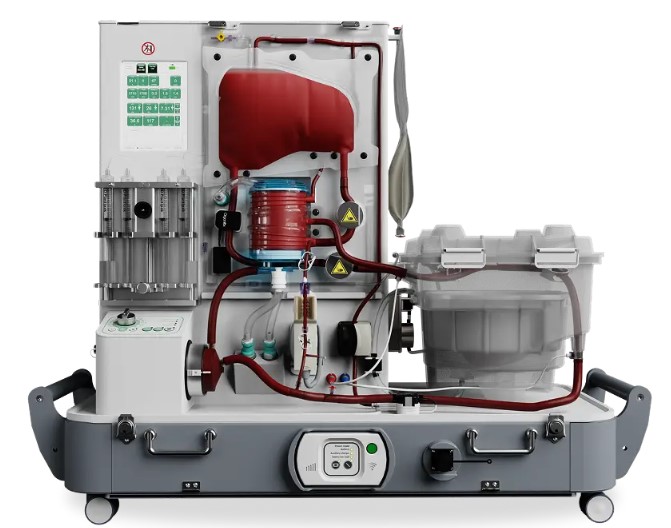
According to a news release, the liver was taken on a 17-hour journey from San Antonio to San Diego while being maintained on the OrganOx metra perfusion system, which supports donated livers at body temperature, providing oxygen, blood, and nutrients during transport.
What you should know
TOSA officials said more than 9,000 U.S. adults and children are waiting to receive the donation of a liver, the only organ that can regenerate itself.
McDaniel was diagnosed with cirrhosis, the result of what she called a negative lifestyle. She changed her habits, and was prescribed medication for her condition, then taken off the drugs.
But regarding receiving a new liver, McDaniel was told by her physicians that because of her Model for End-Stage Liver Disease score, there was no urgency for her to be given priority on a transplant list.
“I really didn’t need a new liver unless somebody gifted it to me, but I would never ask somebody to give it to me,” McDaniel said. “I know several people offered to give me part of their liver, but unfortunately, I needed the whole liver.”
McDaniel’s condition turned urgent in 2020 when she was diagnosed with liver cancer.
“It was aggressive. It was growing rather fast,” McDaniel said.
McDaniel was given higher priority on a liver transplant list. She received three offers where a matching liver was found to be available, but each time something – like a donor’s family changing their mind – happened and McDaniel kept waiting.
Finally, a matching donor, a recently deceased woman in her 70s, was found for McDaniel. She said, initially, she felt undeserving of the liver donation because of the previous lifestyle that led to her developing cirrhosis.
“I didn’t think it deserved it, to be quite honest. My lifestyle was not the nicest thing that I’ve done,” McDaniel said. “But later, in a sense, I did feel like I deserved it because I realized it is part of my story, but it’s not who I am.”
Having recently turned 60, McDaniel volunteers with TOSA, and participates with groups such as Texas Life Warriors, joining fellow transplant recipients, and organ donors, caregivers, loved ones and friends in honoring donor families, and sharing stories. McDaniel advocates for organ donor registration, and how to support recipients in their day-to-day recovery,
“Whatever I learned about my transplant, I try to share that with others,” she said. McDaniel also promotes a healthy lifestyle, although she knows each person she engages –including her own sons – are free to make up their own mind.
“I tried very hard not to be a hypocrite because of what I did to myself,” she added. “I have sons that I tried to share what I’ve gone through in order to get them prepared. You don’t believe something until it happens to you.”
McDaniel, however, is grateful for a new lease on life and grateful to supporters such as TOSA.
“When I’m doing something with TOSA and when someone says ‘I’m a donor,’ I tell them, ‘Thank you,’ because even though they didn’t donate, it’s people like them that saved my life, and I am so thankful,” she added.
A larger perspective
Dr. Joe Nespral, the alliance’s president, said it is recipients such as McDaniel who inspire TOSA, and who are the reason that promotional campaigns such as National Liver Awareness Month must succeed in their mission.
“The first part of this campaign is, let’s educate the public on what to avoid and keep your liver healthy. The secondary part of the campaign is, once you do have liver problems, what are your options?” Nespral said.
“Unfortunately, for certain patients, the only other option for them to survive is a liver transplant. That doesn’t mean that everyone needs a liver transplant, but for certain patients, they don’t have any other choice. If they do not receive a transplant, there’s really no other alternatives for them to survive, so that’s where we come in.”
Similar educational campaigns, such as those that raise awareness of cardiac or kidney disease, enable organizations such as TOSA to inform the public about keeping one’s heart or kidneys healthy – or exploring their options should those organs begin to fail.
According to Nespral, TOSA works through a complicated system of laws, rules and regulations to collaborate with a network of organizations, agencies and health care providers to either locate a matching organ for a recipient in need, or to support an organ donor and their family through the desired end result.
“Everything falls into the education part of trying to prevent the diseases that could eventually lead to a transplant,” Nespral said.
Additionally, organizations such as TOSA keeps the public updated on medical advances that can aid them in their mission. In the case of the OrganOx, it’s a device that has only received approval from the federal government in the past couple of years.
Nespral said the OrganOx is a giant leap forward in the long-standing practice of preserving a recently donated organ. Timing is always important in getting an organ safely to the intended recipient.
“Historically and still to this day, an organ would be preserved in special solutions and in a cooler with ice, and it would be shipped to wherever it’s going to go. The problem with that is that you have time limitations,” Nespral said. “They call that ischemic time – the length of time an organ is out of a body and not receiving blood.”
The length of time that an organ can remain viable during transport depends on the organ in question, something that can be further affected by variables such as weather or traffic on the road.
But a device such as the OrganOx perfusing warm blood through an organ in transport can extend those times, even on greater distances, Nespral said.
Even if it has seemingly taken too long for an organ to safely be transplanted into a recipient’s body, the organ can still be connected to a device such as the OrganOx and possibly resuscitated, and a transplant can proceed, Nespral added.
“The beauty of this new technology is not just extending time, but providing a second chance,” Nespral said. “We can put the organ on that pump and let that organ come back to normal function, give it time and, and we can monitor it to see if it functions normally. If it’s a good organ, even if it went through a period of shock, it can come back to normal, so we could resuscitate that organ.”
Nespral said where organ transplant medicine is concerned, the envelope keeps getting pushed, so that individuals in need such as Debbie McDaniel can be ultimately helped.
“That’s how medicine works. You keep on experimenting and pushing. Because of this technology, an organ gets transplanted and a patient gets saved,” he said.