By Edmond Ortiz
Bexar County will develop an initiative meant to offer short-term, immediate aid to eligible homeowners and renters who are at risk of eviction.
This program is part of the county’s ever-growing effort to address housing affordability.
What you should know
County commissioners voted 4-1 on Nov. 18 to use $500,000 in revenues from the Bexar County Housing Finance Corp. to launch a housing stability program.
County Judge Peter Sakai and Pct. 4 Commissioner Tommy Calvert sponsored the effort, which they said will extend flexible, rapid financial relief to stabilize households where the tenants are facing possible eviction.
The new program would also connect clients to supportive services, and work to prevent those clients from becoming homeless.
The county program is being reserved for residents in unincorporated areas of Bexar County and incorporated small cities inside Bexar County that do not have access to housing assistance programs offered by the city of San Antonio.
What they are saying
Robert Reyna, the county’s community development and housing program director, briefed Commissioners Court about the program, saying many households in areas targeted by the initiative are experiencing “significant financial strain due to economic factors beyond their control.”
“Housing costs are rising faster than wages, and families are having to make difficult decisions about how to manage the central expenses while staying current on their rents,” Reyna said. “Each of your offices is hearing from residents seeking assistance, but the county’s COVID-era rental relief funds have been fully expended.”
According to Reyna, the recent federal government shutdown has exacerbated situations for many local families, particularly veterans, single-parent households and seniors.
“With the possibility of another shutdown in January…it’s important that the county be prepared,” Reyna said.
Reyna said data shows that 22,116 eviction cases were filed between January and October 2025, with 82% of those cases involving San Antonio residents. While the remaining 18% of eviction cases affected residents in unincorporated Bexar County or in suburban cities, none of those residents are eligible for city of San Antonio rental aid.
Reyna said the average arrearage, or amount of unpaid mortgage or rent payments, is $2,747, an amount that he added many families cannot cover once they fall behind.
“These evictions also placed added pressure on shelters such as Haven for Hope,” Reyna said.
In the housing stability program, Sakai and Calvert proposed offering a maximum rental subsidy of $3,500 per eligible household that is earning up to 80% of the area median income.
Calvert said rising costs of utilities, home and rental insurance and other expenses are adding to the burden of financially strapped residents.
“As we enter the new year, I think we’re going to see a real challenge with people’s costs,” he added.
Pct. 2 Commissioner Justin Rodriguez said data shows a significant amount of eviction filings occurring in his precinct, adding that there is a disproportionate number of renters in Precinct 2 suburbs such as Balcones Heights and Leon Valley.
“I think this is something we need to do to help folks,” he added.
Pct. 3 Commissioner Grant Moody cast the lone dissenting vote on the housing stability program. He expressed various concerns, such as whether the county would have to tap into its general fund if the program were to expand. He also said $3,500 may not go a long way for renters or homeowners who are in a larger financial bind.
Additionally, Moody asked how eligible households will be chosen to receive assistance. While saying he appreciated efforts to increase affordable housing, Moody said it is not up to the county government to directly help certain, financially struggling residents.
Instead, Moody suggested that, based on feedback from developers and homebuilders, the county could decrease regulations and bureaucratic red tape related to residential construction, particularly the building of affordable homes.
“At the end of the day, what else can we do besides helping the free market solve people’s housing problems? Because there’s an endless need that would consume our entire county budget if we try to bail out every renter and every homeowner who fell behind on their payments,” he added.
What is next
Now that Commissioners Court has approved of the creation of a housing stability program, county staff is tasked with developing a detailed design for the initiative in partnership with an organization such as Catholic Charities, which will administer the funds to eligible applicants. County staff will then return to Commissioners Court with a detailed program.
Other affordable housing initiatives
Sakai had made addressing housing affordability a priority during his campaign for county judge in the 2022 election, and it appears it will again be a major issue for Sakai, whose re-election bid faces a challenge from former San Antonio Mayor Ron Nirenberg in the 2026 Democratic primary.
The county continues to extend funds for affordable residential developments. In recent weeks, county leaders celebrated the opening of Aviator 1518, an affordable, 300-unit multifamily community in south Schertz, and Village at the Loop, a 92-unit multifamily community featuring 80 affordable apartments and 12 market-rate units in northeast San Antonio.
The county used a combined $1.8 million in federal American Rescue Plan Act funds to help support both of these developments.
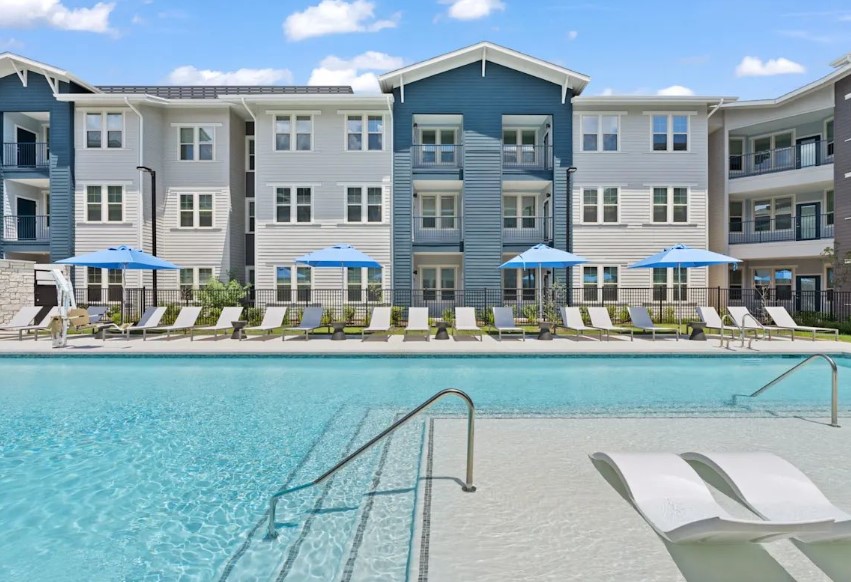
More county-backed affordable housing developments are in the works. Commissioners on Nov. 18 passed resolutions endorsing two affordable residential projects whose respective developers are applying for housing tax credits from the state.
In one project, NRP Lone Star Development aims to build The 301 Lofts, a 336-unit affordable apartment complex at the corner of Texas Highway 211 and U.S. Highway 90 in unincorporated far west Bexar County.
County commissioners in August allocated nearly $670,000 in HOME Investment Partnerships Program funds for The 301 Lofts. NRP Lone Star expects to begin construction on this $86 million development in August 2026, and wrap up work in fall 2028.
In the second project, Kittle Property Group and Bexar Management Development Corp. plan to build Cactus Trails Apartments, a 248-unit, affordable senior housing community on Shaenfield Road in Helotes’ extraterritorial jurisdiction. BMDC is a subsidiary of the Housing Authority of Bexar County.
Plans call for Cactus Trails to include on-site supportive services for tenants, such as a food pantry, social and recreational activities, and yearly income tax preparation and a health fair. Construction on the $62 million development is slated to start in August 2026 and be completed in July 2028.