By Edmond Ortiz
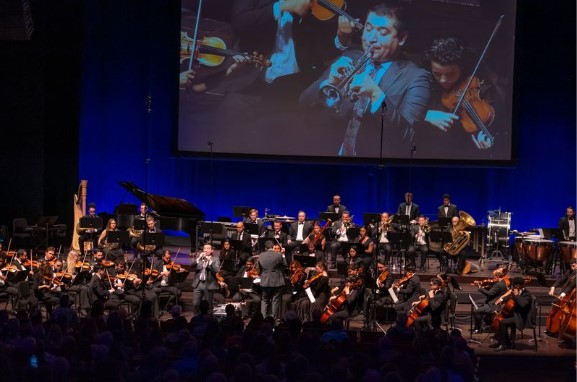
The Orchestra San Antonio’s March 27 lunchtime show at the Tobin Center for the Performing Arts marks the organization’s expansion of music educational support for area youth.
What is happening
The Orchestra San Antonio’s (TOSA) Youth Concert Series debuts with a noon concert that is free and open to the community.
But this and future youth performances from TOSA are designed to especially appeal to elementary, middle and high school pupils, including those who are playing in a school band.
The interactive March 27 show, titled “American Harmony,” will feature excerpts of the following compositions: Antonín Dvořák’s Symphony No. 9 in E Minor, Op. 95; Leonard Bernstein’s three dance episodes from “On the Town,” and Daniel Freiberg’s “Crónicas Latinoamericanas” trumpet concerto. Freiberg himself will play at the student-centric show.
The select pieces span diverse musical eras, from traditional 1800s symphonic sounds and 1940s Broadway to modern-day Latin jazz.
Paul Montalvo, The Orchestra San Antonio’s CEO, said TOSA team members curated the program to tie it into a 7:30 p.m. March 28 performance, which will feature the musical selections from the prior day’s show, and trace the evolution of jazz, a singularly American musical invention.
Renowned trumpeter Pacho Flores will take part in a pre-concert discussion about music, that night’s show and the creative process.
In an effort to help educate students about music, The Orchestra made available to educators an online guide that briefly explores the origins of orchestral music, and the inspirational experiences for the three select compositions.
The teachers’ guide also suggests post-show questions that could be posed to elementary or middle or high schoolers about the compositions they heard in the concert.
Students are also invited to consider how one musician’s surroundings influence the music they create, and how music helps to shape communities.
Additionally, the teaching guide is aligned with Texas Essential Knowledge and Skills (TEKS) educational standards, offering a variety of grade-appropriate lesson plans.
TOSA created the educators’ guide in collaboration with Generation NEXT, the Tobin Center’s program that is designed to shrink the gap between the fine arts and public education.
What they are saying
Montalvo said TOSA’s youth concerts echo the type of performances that the San Antonio Symphony once offered for school field trips, but that in this case, there is interaction between students and musicians.
“This is much more educational based,” Montalvo said. “The aim here is to slowly build upon (past symphony student shows) and offer more of these programs, so that more students can come here and see what we’re doing.”
The Orchestra’s youth concert series is just one part of the organization’s larger push to help broaden the educational and artistic horizons of local children and teenagers.
TOSA also offers Ascend, a free, after-school program that provides comprehensive classical music education experiences to students who otherwise may not be able to easily access music programs in their schools or communities. Orchestra artists serve as Ascend faculty members.
Ascend is available to all students around Bexar County and surrounding areas. The program currently serves about 100 students total between two elementary campuses in the Edgewood and San Antonio independent school districts.
“We always want to bring this educational base to everything that we do, and I think that’s the aim – to introduce and highlight certain things that might not be known to many students,” Montalvo said. “For a lot of them, they get a glimpse of something outside San Antonio and their zip code.”
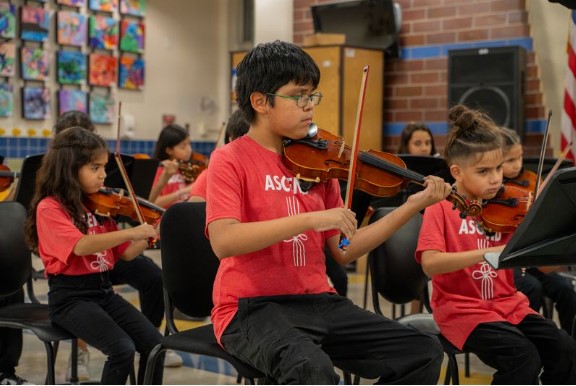
Mariana Vela, TOSA’s vice president of media and marketing, said many Ascend students are first-generation musicians or instrumentalists in their family.
“We just did interviews with the kids, and they always mention how their parents shed a tear when they see their kids perform,” Vela added.
While The Orchestra San Antonio works to extend musical education to area youth in different ways, Montalvo said efforts to grow such programs – and TOSA itself – are carefully calculated in a time when fine arts might receive lower priority in schools or in some communities, and art-focused nonprofits are grappling for funding.
For example, major challenges face the San Antonio Philharmonic, which includes many former San Antonio Symphony musicians. The Philharmonic in February canceled the rest of its season, as organizational officials cited difficulty securing per-performance funding.
Also, owners of the Scottish Rite Hall, the Philharmonic’s former show venue, evicted the group. The Philharmonic earlier this month filed a counter claim in district court, seeking more than $1 million in damages in a legal dispute with the Scottish Rite Hall’s ownership organization.
But despite various obstacles in the arts landscape, classical music organizations across the San Antonio area are doing what they can to operate and thrive by entertaining and educating audiences and students, according to Montalvo. TOSA’s youth concert series and Ascend program are two such means to this end, he added.
“We’re building with caution because we have to see what’s sustainable,” Montalvo said. “There’s lot of opportunities for people to experience classical music in some intimate settings and in very innovative ways.”
Entry to TOSA Youth Concert Series is free, but patrons must register at the orchestra website for a ticket. Admission for the March 28 show, also at the Tobin Center, starts at $27.